

Mutually Assured Derangement
How selection effects and epistemic failure solved the trust problem (by destroying it)


Briefly stated, the Gell-Mann Amnesia effect works as follows. You open the newspaper to an article on some subject you know well. In Murray’s case, physics. In mine, show business. You read the article and see the journalist has absolutely no understanding of either the facts or the issues. Often, the article is so wrong it actually presents the story backward—reversing cause and effect. I call these the “wet streets cause rain” stories. Paper’s full of them.
In any case, you read with exasperation or amusement the multiple errors in a story—and then turn the page to national or international affairs, and read with renewed interest as if the rest of the newspaper was somehow more accurate about far-off Palestine than it was about the story you just read. You turn the page, and forget what you know.
That is the Gell-Mann Amnesia effect. I’d point out it does not operate in other arenas of life. In ordinary life, if somebody consistently exaggerates or lies to you, you soon discount everything they say. In court, there is the legal doctrine of falsus in uno, falsus in omnibus, which means untruthful in one part, untruthful in all. But when it comes to the media, we believe against evidence that it is probably worth our time to read other parts of the paper. When, in fact, it almost certainly isn’t. The only possible explanation for our behavior is amnesia.
— Michael Crichton, “Why Speculate?” (2002)
I’ve always been fond of the Gell-Mann Amnesia effect as a theory, as it very accurately describes my own experience with the media due to my own expertise on the subject of firearms, which journalists frequently gets comically incorrect and, more damningly, always in the same direction. Unlike the hypothetical reader that Crichton describes however, I didn’t turn the page and assume I was reading the accurate truth on topics I didn’t have firsthand knowledge of, instead I steadily adjusted my trust in whatever media organization had published the bad information downward, and I did this across the multiple domains in which I happened to have some experience that clashed with what was being reported as reality.
This wasn’t merely a problem I had with the media either, I repeatedly had the same issue with academic studies, where a brief glance past the abstract revealed shockingly biased methods or assumptions, with gun stuff again being the thin edge of the wedge as that’s the area where I not only have the most genuine expertise, but also gained it at the earliest age. The most vivid example I remember was the Kellerman study from the 80s that argued that a gun in the home led to a 3X risk for homicide and a 5X risk for suicide, which was widely cited for years in the media and by politicians and activists. Yet when I dug into the study myself I discovered that the way they’d arrived at those numbers was by working backwards from murders and suicides where a gun had been used, not surveying gun owners generally and looking at the homicide/suicide rates, that no attempt had been made to control for defensive gun usage or crime deterrence, they just started with the bad outcomes and worked towards the conclusion they were looking for. This was not fraudulent per se, merely poorly constructed and then weaponized politically.

As this happened repeatedly, my circle of trust contracted, and defensive skepticism became my default mode—taking almost nothing at face value and constantly calculating who was most likely lying, and why.
It was exhausting. I maintained a large bookmarks folder of sites and individual journalists I trusted on specific subjects, so that by reading a piece here and an article there, I could patch together a coherent view of reality that didn’t feel too distorted by bias or manipulation.
Now, I’m a smart enough guy, I didn’t just decide that everything in The New York Times or The Atlantic was automatically false, just that if it touched on politics at all I would treat it with extreme skepticism, more so with explicitly ideological outlets like Slate or Vox, unless it was run against interest, such as one of those outlets praising a Republican or criticizing a Democrat (and not just for being insufficiently progressive).
As to right wing outlets, I honestly didn’t bother, as all of them were explicitly ideological and I was never able to stand their tone; I’m not temperamentally conservative and I’m neither religious nor big on moralizing, so I found them uniformly off-putting, with the noted exceptions of Reason magazine and National Review, Reason being scrupulously honest and NR being consciously high brow. (I often disagree with Reason these days, but I’ve never felt actively mislead by them)
So, where am I going with this?
Well, I think Crichton was on to something with Gell-Mann Amnesia, but I don’t think he followed it all the way through, and if he had, he’d have seen that it was much more destructive than I believe he realized, and that it explains a number of pervasive trends in US politics. Decades ago it started driving conservatives crazy and making them susceptible to conspiracy theories and the grifters peddling them, and now it’s come for the liberals, who paradoxically might be even more vulnerable to the ill effects.
Now, I want to make very clear that I don’t think there was any sort of grand conspiracy at work here, just basic selection effects compounded over time rather than liberals scheming to bias information production and dissemination apparatuses to pursue their ideological ends, at least in the beginning.
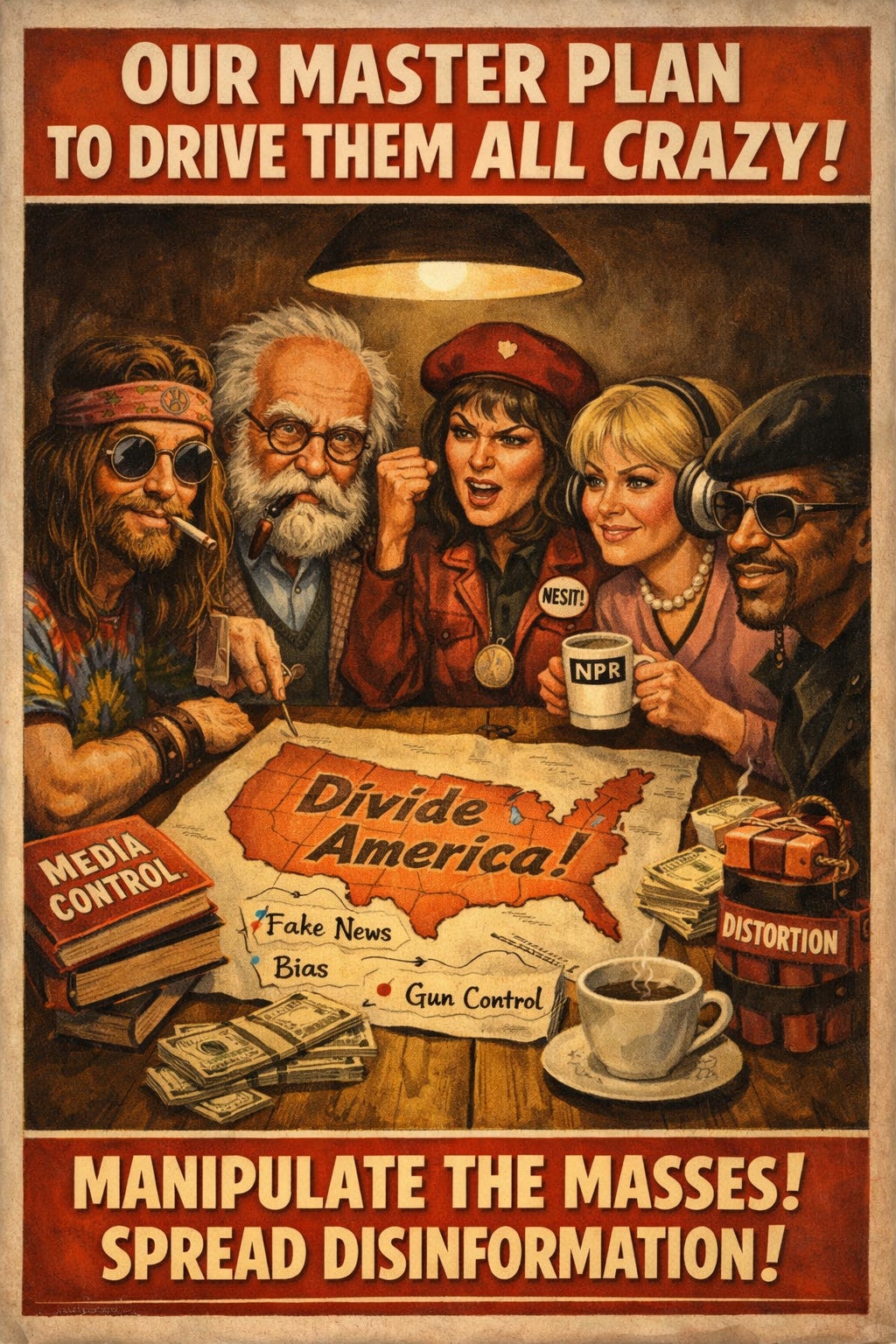
It’s pretty simple, media work selects for people with good verbal intelligence with at least a certain baseline level of education who live in cities big enough to support a paper or a news station, which even without any kind of thumb on the scale is going to mostly capture liberals. Those liberals are then expected to cover stories that come from all different areas and domains, most of which they’re going to be unfamiliar with, so mistakes are going to be made both in how certain stories are covered and even some basic facts that are not common knowledge outside of particular areas or occupations, which are disproportionately going to be the areas and occupations that conservatives are familiar with. To the conservative observer, this looks intentional, the mistakes are always in the same places and always going in the same direction, so it seems natural to conclude that the media (and academia, through a similar mechanism) are in the tank for the liberals and thus not to be trusted, and alternative sources of information have to be sought out.
This is where the problems really start.
I’ll start with the psychological effects on conservatives, because I think they explain a great deal about contemporary American political dynamics. Growing up in a liberal area, I was taught, both implicitly and explicitly, that conservatives were stupid. They believed outrageous things, rejected scientific facts, fell for scams and cults, clung to bizarre religious ideas, and were fundamentally unreachable by reason.
When I actually encountered conservatives in significant numbers in my early twenties, while attending gunsmithing school, that caricature collapsed almost immediately. They were not the drooling imbeciles or hostile bigots I had been led to expect. They were generally decent people, often more tolerant of dissenting opinions than the liberals I’d grown up around. At the same time, many of them did believe some genuinely strange, conspiratorial things, and once those beliefs set in, they could be remarkably hard to dislodge.
These weren’t stupid people. They had simply encountered too many untrue or misleading claims printed in papers of record or presented as settled fact by the stewards of knowledge to retain any trust in them at all. Over time, this trained two responses simultaneously: a reflexive mechanism for dismissing information they didn’t want to hear as lies, and a growing vulnerability to unscrupulous or unstable outlets willing to tell them what they wanted to hear.
They were not wrong to notice that media and academia exhibited a consistent bias in a particular direction. Where they went wrong was in responding by constructing parallel epistemic bubbles, admitting only selective fragments of reality, and gradually unmooring themselves from any shared framework for adjudicating truth.
This is the piece missing from much of the criticism of the American right. Their embrace of fringe beliefs is usually attributed to stupidity, religiosity, or mass delusion, when in reality it followed from rational and concrete reasons to lose trust in the institutions the rest of society relies on to describe the world. Once that trust collapses, the descent into unreality is not abrupt but slippery, incremental, and difficult to arrest.
I strongly suspect that if the average liberal had grown up in a world where multiple FOX News clones were treated as neutral arbiters, and the academy consisted largely of Liberty University–style institutions with a token handful of liberal colleges held up for ridicule, they would have followed much the same trajectory. I may be getting ahead of myself, but the symmetry is hard to ignore.
The next phase is almost poetic in its irony, approaching Greek tragedy in structure if not in scale. The earlier, largely unintentional leftward slant of the mainstream media created a genuine market gap. That gap was first filled by AM talk radio, tabloid papers, and other dubious purveyors of “news” that, whatever their flaws, at least did not openly sneer at their audience for holding non-coastal liberal views.
Eventually, this demand was met by Fox News, which one wit famously described as having “identified an underserved slice of the market: the other half of the country.” Fox claimed that it operated a straight news desk, no different in principle from the legacy media, while confining its ideological commitments to explicitly labeled opinion programming. Formally, this mirrored the model its competitors insisted they were following.
In practice, however, it was obvious that the rightward tilt did not switch off once Hannity or O’Reilly left the camera. The slant merely became more restrained, less performative, more selective. Story choice, framing, and emphasis did the work that overt editorializing no longer needed to do. The distinction between “news” and “opinion” remained intact as a matter of branding, even as the spirit of neutrality quietly dissolved.
One might have hoped that legacy media would look in the mirror and attempt to win back the audiences they were losing, or at least seriously interrogate why they were being outcompeted by an upstart network with, frankly, amateur-hour production values. That is not what happened. Instead, they doubled down on existing practices, a move made easier as right-leaning talent departed for the now-ascendant Fox.
Crucially, none of these institutions ever abandoned the pretense of neutrality. Even as they attacked Fox as a partisan propaganda outlet, they remained oblivious to the fact that this was precisely how they had long been perceived by much of the country. To red America, these were not neutral journalists responding to a bad actor; they were ideological peers objecting to competition.
Over time, this defensive posture hardened into something more explicit. Faced with conservative media willing to fight openly, legacy outlets increasingly adopted a “fight fire with fire” mentality, tilting further left while still insisting on their own objectivity. What they seemed not to notice was that conservatives were no longer the audience. The only people still listening were liberals.

This is where the “mutual” part of Mutually Assured Derangement begins to matter. Having already driven off conservative viewers with a subtle but persistent bias, legacy media abandoned subtlety altogether and began behaving much as conservatives had accused them of for years. The resulting blast of partisan framing did not radicalize the right, who were long gone, but instead landed squarely on normie liberals, who had never developed the same reflexive skepticism toward their own institutions.
We now find ourselves in a position where the left is speed-running a process that took the right decades to complete, aided by far more powerful communications tools and lacking the hard-earned skepticism that long exposure to hostile institutions once produced. In hindsight, the 2016 reaction to Nate Silver’s election forecasts was the real harbinger.
Silver’s models gave Donald Trump roughly a thirty percent chance of winning, hardly a prediction, merely an uncomfortable fact about uncertainty. The response from many elite liberals was not to argue with the data, but to express anger that it was being reported at all, as though acknowledging the possibility itself was irresponsible or even immoral. It was the first time I remember seeing credentialed journalists and commentators openly resent a reporter for telling them something they did not want to hear, on the apparent theory that silence might somehow make it untrue.
Things only went downhill from there. I don’t feel any need to rehash the details of the first Trump term; the Russia! Russia! Russia! melodrama that never seemed to pay off or get meaningfully walked back, the breathless coverage of whatever fresh outrage Trump had supposedly committed that routinely fell apart once the unedited video circulated (“very fine people on both sides” remains the standout), or COVID turning everything up to eleven as public health officials contradicted themselves in real time while reporters delivered on-screen cognitive dissonance (“fiery but peaceful”).
I bring these up not to tally grievances or score political points, just to provide examples of the information diet liberals were consuming day after day, and the effects it had on them. Saturation in selectively framed narratives, moralized certainty, and corrections that never fully materialized produced the same epistemic distortions liberals had long mocked conservatives for developing inside the Fox bubble. The mechanism was identical, but working much faster on a population with no immune system for institutional bias and distortion.
I’ll close with a personal admission, because it took one to fully understand what I’d been describing. For years, I’d resented what I saw as a pervasive liberal bias in the media and related institutions, and I really resented all of the extra labor I had to put in to triangulate the truth. I assumed liberals knew about the slant, recognized the distortions, and simply accepted them as the cost of winning political battles. I thought they were tacitly accepting, if not actively complicit.
In 2024, I realized how wrong that assumption was. Watching friends, the smart and political aware ones, insist with complete sincerity that Joe Biden was not meaningfully diminished forced a reevaluation. These weren’t cynical partisans pretending not to see what was obvious, they genuinely could not see it. The realization was jarring: the things I had assumed were knowingly propagated lies were, for many people, sincerely held beliefs.

That was the moment my view shifted. I stopped seeing ordinary liberals as architects of a deception and began to see them as casualties of it. They had trusted institutions I had learned, painfully and early, to question. When those institutions bent reality for partisan ends, liberals absorbed the distortion not because they were malicious or dishonest, but because they had never been trained to expect it. It wasn’t exactly the same process that had driven the right to madness, but the end result was similar enough that it didn’t really matter.
This is what makes the current moment so dangerous. Each side now believes the other is lying on purpose, when in fact both are increasingly trapped inside information systems that reward certainty, punish doubt, and quietly sever their users from shared reality. Mutually assured derangement is not sustained by bad people acting in bad faith, but by ordinary people trusting institutions that no longer deserve the kind of trust they demand.
This was a great read. You've accurately captured the long-running frustration that conservatives have had with legacy media that drove them to seek alternate news sources. It used to drive me crazy.
Really makes you wonder whether it's even possible to heal this divide when basic reality is up for debate
Appreciate this essay. I’ve had several moments in the past several years where I’ve asked myself, “how don’t people see what I am seeing?” My trajectory doesn’t exactly mirrors yours but I’m thinking we have arrived at the same ballpark.